Estimate Reconciliation
Every cut the carrier made, line by line.
Upload your preliminary estimate and the insurer's estimate of record. Get back a PDF of every difference between them — the reduced labor hour, the operation changed from Repl to Rpr, the part priced lower, the line only one side wrote.
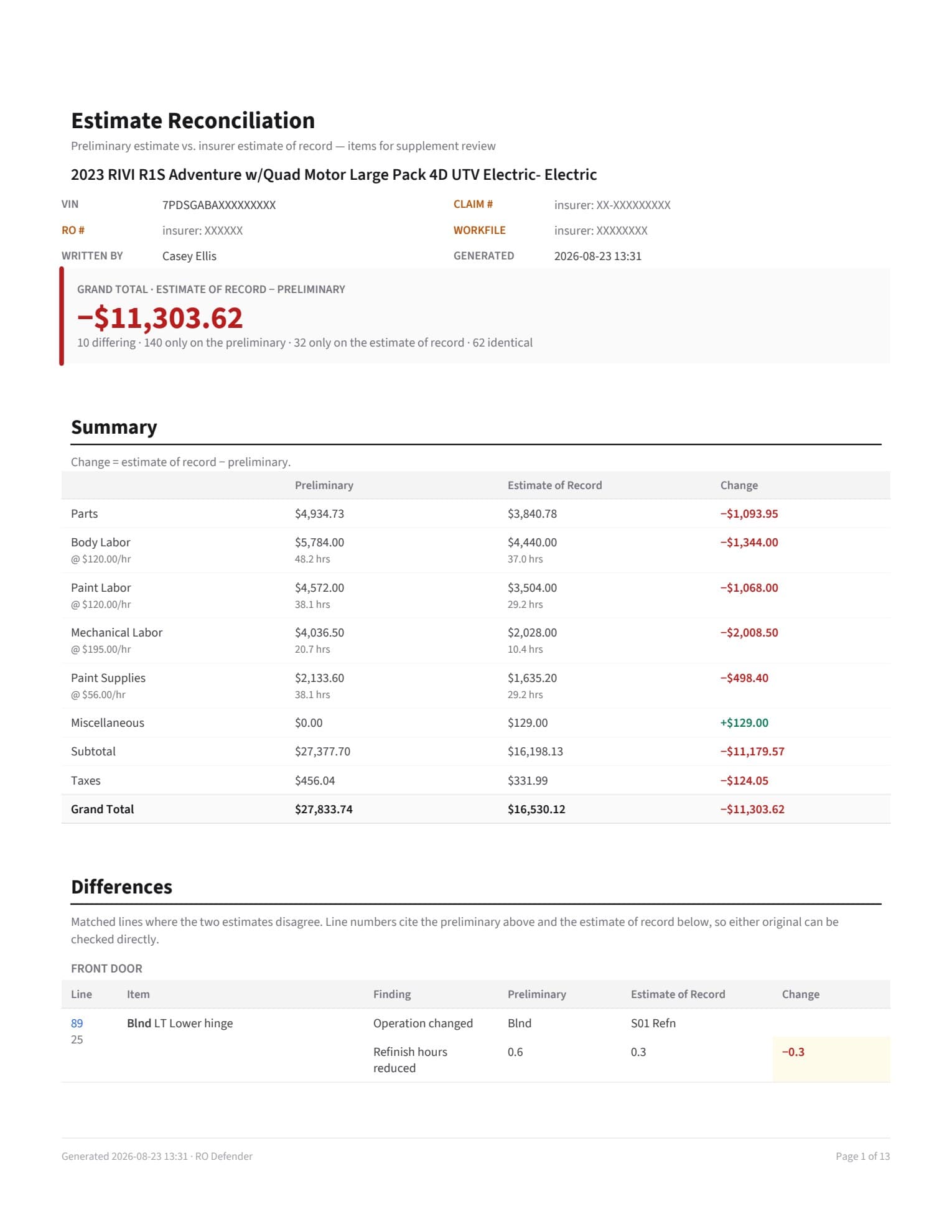
Two estimates for the same repair rarely line up. Line numbers shift, descriptions are reworded, and one side splits what the other wrote as one line. Finding the differences by hand means reading both documents side by side, line by line — an afternoon for a large repair.
The report does that reading. It pairs the lines that describe the same work, shows exactly what changed on each, and totals the gap by category so you can see where the money went before you open either original.
What's in the report
- The gap, stated once
- The difference between the two estimates' totals, before the deductible, at the top of page one — then broken down by parts, body labor, refinish labor, mechanical labor and materials.
- Every differing line, with a finding
- Each matched pair that disagrees shows what changed: hours reduced, operation changed, part price lowered, quantity changed. Down and up are reported separately, so a line the carrier paid more on never hides one it cut.
- Lines only one side wrote
- Operations on your estimate that are missing from the carrier's, and the reverse — grouped by panel, with their hours and prices.
- Both line numbers on every row
- Your line number and the carrier's, side by side, so any row can be checked against the originals in seconds.
- A vehicle check
- If the VIN or vehicle differs between the two estimates, the report says so above the total — because then the comparison itself is suspect.
- Agreed lines, rolled up
- Lines both sides agree on are summarised by panel, so the report stays about the disagreements.
How it works
- 01
Upload both estimates
Your preliminary and the carrier's estimate of record, as CCC ONE or Mitchell PDFs.
- 02
Check the matching
Review the pairs, and pair or group anything the matcher missed. Your arrangement is saved as you go.
- 03
Download the PDF
A report you can attach to a supplement, hand to an appraiser, or put in a short-pay file.
Common questions
Which estimating systems does it read?
CCC ONE and Mitchell estimates, as the PDFs those systems print. CCC ONE's BMS XML export works too, and it matches more precisely because every line carries an ID that survives supplements.
What if the two estimates number their lines differently?
They usually do — on a real 83-line pair, most matched lines sat at different line numbers on the two estimates. Lines are matched by part number and description, not by position, and the report cites both line numbers so you can find each one in the originals.
What happens to lines it can't match?
They are listed as only on your estimate or only on the carrier's, grouped by panel. Before the report is generated you can pair or group anything the matcher missed — for example one line on your side that the carrier wrote as two.
Is the dollar gap after the deductible?
No. The headline compares the two estimates' totals before the deductible and before any customer-pay split, because that is the number that says what the repair costs. A net-to-insurer figure on a split-liability job can overstate the gap many times over.
Does it write anything back into CCC ONE or Mitchell?
No. It reads the estimates you upload and produces a PDF. Nothing is submitted to a carrier or changed in your estimating system.
What does it cost?
$29 a month for unlimited reconciliations, or $19 for a single one with no subscription. Both tools together are $49 a month.