Repair Cost Statement
Restate the repair, in plain English.
A CCC or Mitchell estimate is a coded list only an estimator can read. Upload one and get a statement anyone can follow: what the labor was, what the parts and materials were, and what work was done — adding up to the estimate to the cent.
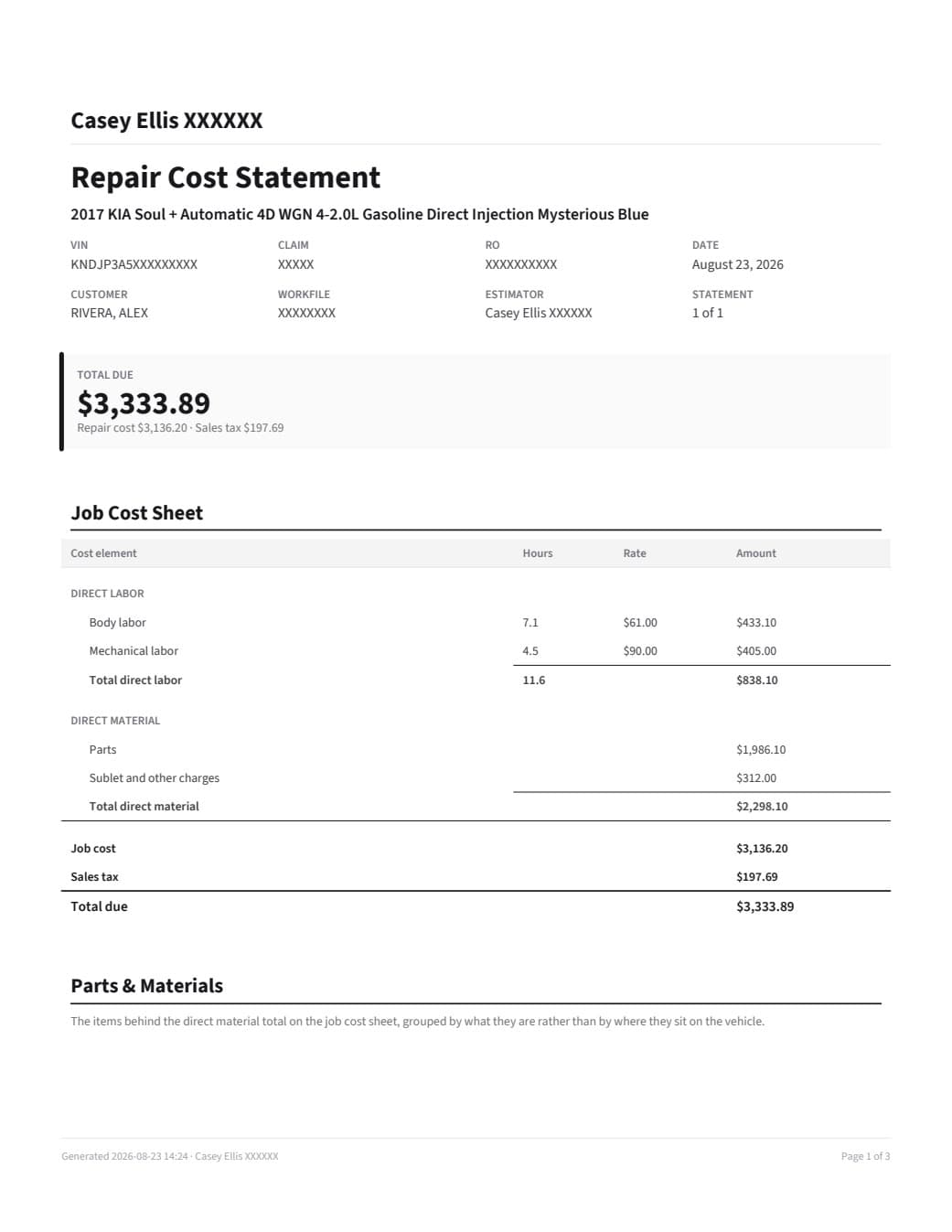
An estimate lists work in the order a technician does it, with operation codes, labor categories and supplement stamps mixed in among the parts. That is exactly what makes it unreadable to the person who has to agree to it.
The statement keeps every figure and changes the organisation: labor by trade, parts and materials in sections a lay reader can name, and the scope of work by operation — then a signature block, because it is a document meant to be accepted.
What's in the statement
- Total due, up front
- The amount, the repair cost and the tax, before anything else.
- A job cost sheet
- Direct labor by trade — body, refinish, mechanical, frame, structural, diagnostic and the shop's own categories — with hours and rates, then direct material. It foots to the estimate's pre-tax total exactly.
- Parts and materials, itemised
- Replacement parts, fasteners, one-time-use parts, shop materials, procedures and fees, and sublet work, each under a plain heading with a sentence explaining it.
- Your notes, where they matter
- Add a note under any part, and write the reason each one-time-use part cannot be reused — the OEM procedure, not a generic sentence.
- Scope of work
- Labor hours by operation, with the panels and assemblies each one touched.
- Certification and acceptance
- Signature lines for the repair facility and the customer.
How it works
- 01
Upload the estimate
One CCC ONE or Mitchell PDF — the preliminary, a supplement, or the estimate of record.
- 02
Review the parts
Move items between sections, edit headings and single-use reasons, add notes. Everything saves as you go.
- 03
Download the statement
A PDF you can hand a customer, attach to an appraisal, or put in front of a jury.
Common questions
Does the statement change the total?
No. It reorganises the estimate rather than repricing it: labor at the estimate's own hours and rates, parts and materials at the estimate's prices. The job cost equals the estimate's pre-tax total to the cent, and tax follows at the estimate's own rate.
Which estimates can I upload?
CCC ONE and Mitchell estimates, as the PDF the estimating system prints. That includes supplements and excerpts — a reviewed supplement that starts at page 2 works.
Can I change how the parts are grouped?
Yes. The parts and materials are sorted automatically into replacement parts, fasteners, one-time-use parts, shop materials, procedures and sublet. Before rendering you can move any item, rename or reorder sections, rewrite the explanation under each heading, and add a note under any part.
What does it say about one-time-use parts?
Parts that generally cannot be reused — rivets, trim clips, locking fasteners, seals — are grouped with a one-sentence reason. Those reasons describe the class of part, not your vehicle's repair procedure, so each is editable: replace it with the OEM procedure you are relying on, or clear it.
Who is it for?
Anyone who has to explain a repair to someone outside the trade — a customer asking why, a mediator in an appraisal, a jury in a property damage case.
What does it cost?
$29 a month for unlimited statements, or $19 for a single statement with no subscription — corrections and re-renders of that document included.